
The Storm
1949 Radio Script inspired by the miraculous accounts found in John 6:16–21

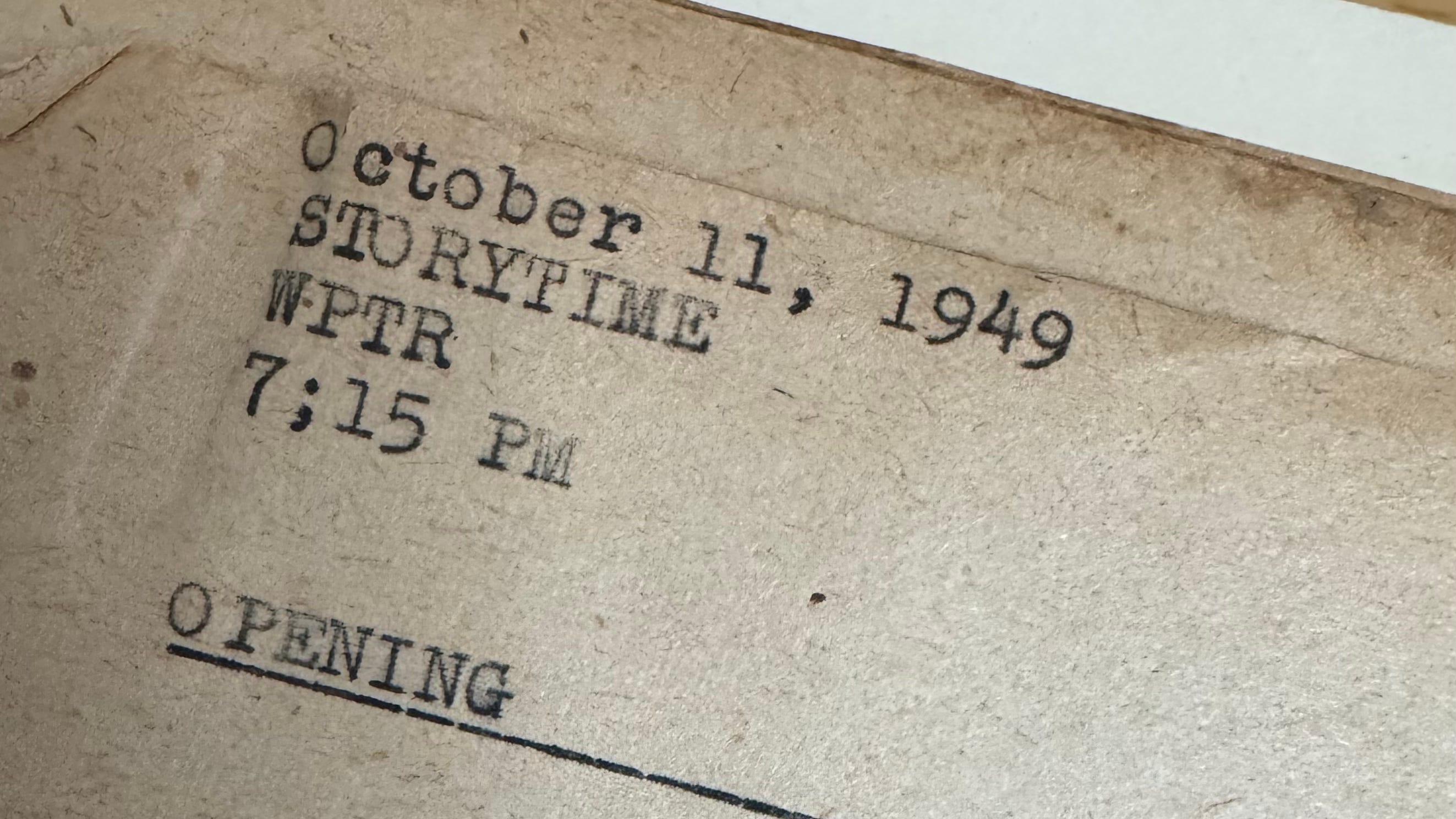
By October 1949, Ethel Barrett was a staple of the airwaves with her weekly radio show, Storytime, sponsored by the Albany Bible Institute. This particular broadcast captured her at a career milestone: having recently won first place in the National Religious Broadcasters' nationwide competition for her transcribed work, she was performing this original story live for her WPTR audience in Albany. Below is the high-fidelity transcription of the original October 11, 1949, broadcast script, including the original stage directions and musical cues.
STORYTIME: THE STORM
Original Broadcast Date: October 11, 1949
Station: WPTR, Albany, NY | 7:15 PM
Author/Performer: Ethel Barrett
ANNCR: (COLD) It’s STORYTIME!
MUSIC: (x-1-3) ESTABLISH; THEN FADE AND HOLD UNDER:
ANNCR: It’s STORYTIME tonight, and every Tuesday evening at this hour with Ethel Barrett. It was a transcribed1 program written and presented by Ethel Barrett, that won first place in the National Religious Broadcasters’ nation-wide 1949 competition and now she’s here in person presented for you by the ALBANY BIBLE INSTITUTE.
MUSIC: OUT.
ANNCR: The staunchest tree is not found in the shelter of the forest, but out in the open where the winds from every quarter beat upon it, and bend and twist it until it becomes a giant in stature. It requires storms to produce the rooting. Ethel Barrett’s story tonite has to do with storms. It may answer a question in your heart. Let’s listen.
MUSIC: (w-38-5) ESTABLISH; THEN OUT.
BOY: Mother—Mother—
MOTHER: I’m in here.
BOY: Hi.
MOTHER: Hi. The fellows were looking for you.
BOY: They were?
MOTHER: They were. (PAUSE) Well—your enthusiasm is contagious.
BOY: Hm?
MOTHER: You don’t sound very excited. You don’t sound even curious. Don’t you want to know what they wanted?
BOY: What’d they want?
MOTHER: They’ve gone over to watch them tear up Main Street. There’s a very exciting steam-shovel over there, among other numerous and sundry gadgets that I can’t name.
BOY: Uh huh.
MOTHER: Saaaaay! Something IS wrong with you. Don’t you feel well? (PAUSE) I’m sorry.
BOY: That’s okay.
MOTHER: Want to talk about it?
BOY: I—can’t. I don’t have it figured out yet.
MOTHER: Well, maybe we can pray about it—and get it “figured out” together.
BOY: No—I’d rather wait ‘till I’ve straightened it out before I tell you about it. I’m ashamed to tell you now. I’m licked. I’m just licked.
MOTHER: No Christian is ever licked. Just because it isn’t “smooth sailing” doesn’t mean you’re licked. You’re just riding through a storm, that’s all. (Pause) There were some men once—who thought they were licked. They were riding through a storm. (Pause) Would you like to hear it?
BOY: No— I’m too busy thinking.
MOTHER: Well, maybe this story will help you think. Tell you what. I’ll just give you a preview of the story, and if you don’t want to hear it— I’ll save the rest ‘till some other time.
BOY: It’s about a storm?
MOTHER: Mmmmmm. A WICKED storm.
BOY: Go ahead.
MUSIC: SET SCENE FOR STORM; ESTABLISH, THEN DOWN UNDER FOR:
“It’s no use—the waves are too high—furl the sail!”
Furl the sail! The sail came tumbling down—CRASH!
“Don’t lash it down—just make the boom fast!”
They struggled with the heavy boom that held the sail, pulled it (HIKE) to the middle of the boat and (BUSINESS) lashed it fast with rope.
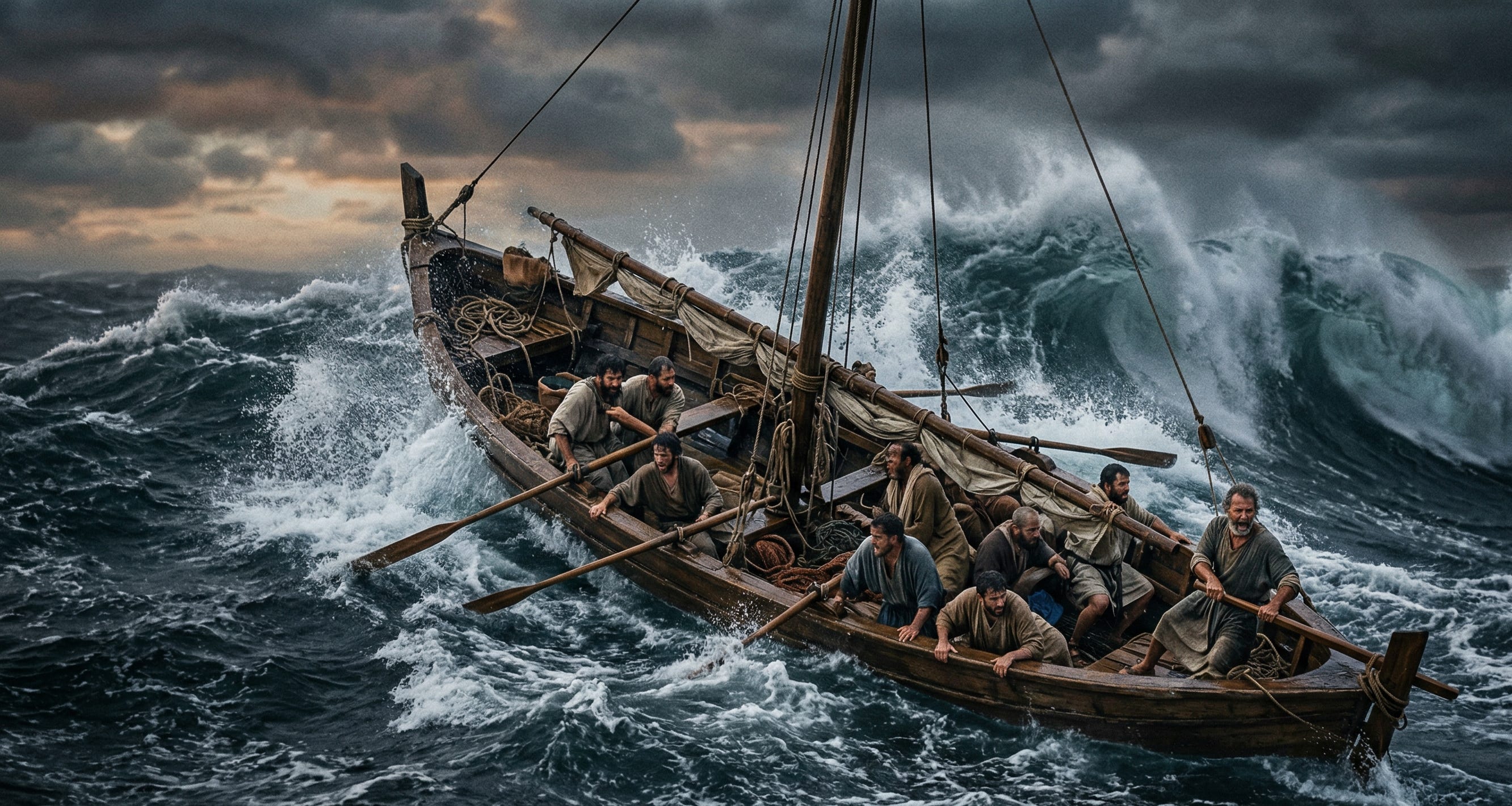
“Break out the oars! Look alive on that tiller—keep her headed into the waves! Don’t let her head slide off into the trough! If one of those waves catches her broadside, we haven’t got a chance!”
Yes, the way things looked, they DIDN’T have a chance. The little boat was being tossed about as if it were no bigger than a wall-nut shell. They were goners.
MUSIC: OUT (wait for cue)
MOTHER: Who were these men? That’s the exciting part of a real true story! Well I guess I got ahead of myself. Want to hear the rest?
BOY: Yep.
It all began really—back on land. The Lord Jesus Christ had been preaching and teaching—and oh—the people who followed Him! If it were today, you’d say he was a sensation! Wherever He went, multitudes followed Him to hear Him talk. And just before this story opens—He had fed way over five thousand people from just a few rolls of bread and a few fish! Why, people were in a fever pitch of excitement! They wanted to make Him King. It says in the gospel of John, they were ready to take Him by force—and insist that He be their King, then and there. But Jesus hadn’t come to set up an earthly kingdom—he’d come to pay the price for mens’ sin on Calvary’s Cross—He was no ordinary king—He was the lamb of God—and when He comes again He’ll be King—but that’s another story.
These people meant alright but they didn’t understand, and they wanted Him to be king. And He said to His disciples—”Get into your boat, and go across to the other side of the lake. After I send these people away—I want to stay here and pray.”
Oh—they didn’t want to go. They’d caught the excitement too—and they didn’t want to leave Him alone. But in the end, they did. They got in their boat hoisted—the anchor aboard—took an oar and shoved off—swung her about—and ran up the sail.
I think they were disappointed men, those disciples. It would have been wonderful for their Jesus to be a king. But right in the middle of all the excitement, He’d made them go away—and He had gone alone into the mountain to pray.
MUSIC: ( ) SNEAK IN SUITABLE B G UNDER FOLLOWING:
The sail bellied out—as the wind filled—and the boat started out from shore. Oh—it was beautiful—the moon made a path—like burnished silver across the water—and the boat was in that path, all splashed with moon-light—like a picture—and the water went slap-slap-slap-slap.
Then—Hmmmm. Straightened up. Wind started changing direction—it was coming TOWARD them, driving them back. The slap-slap-slap turned to chop-chop-chop-chop. They began to get busy.
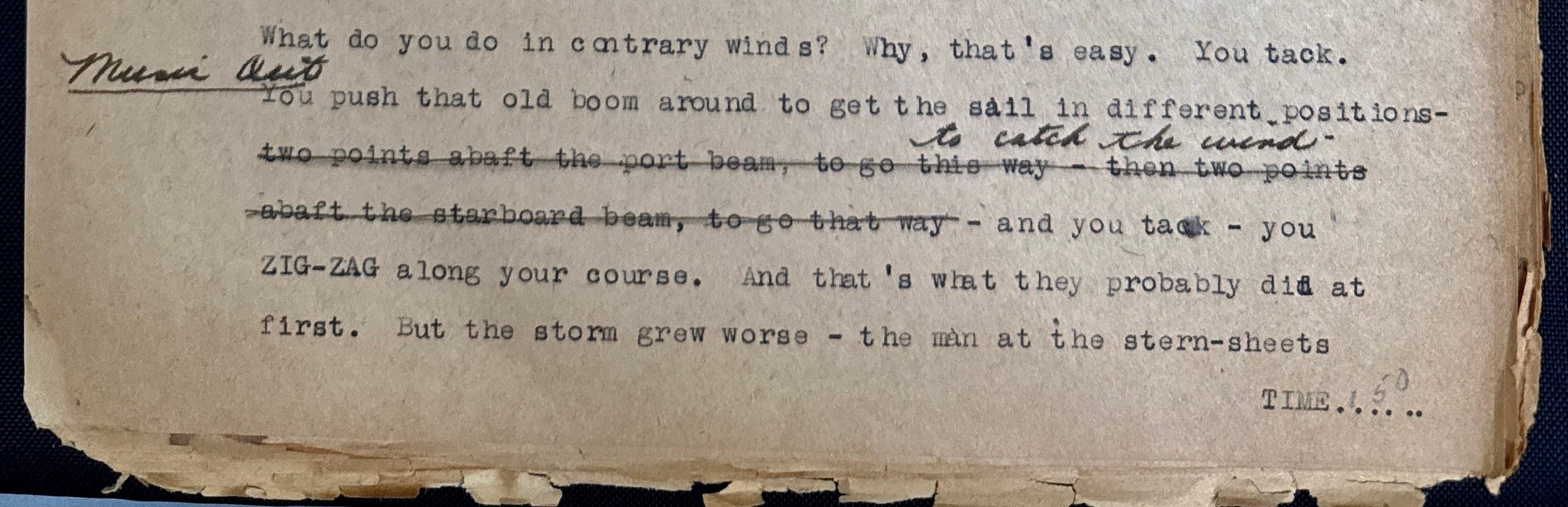
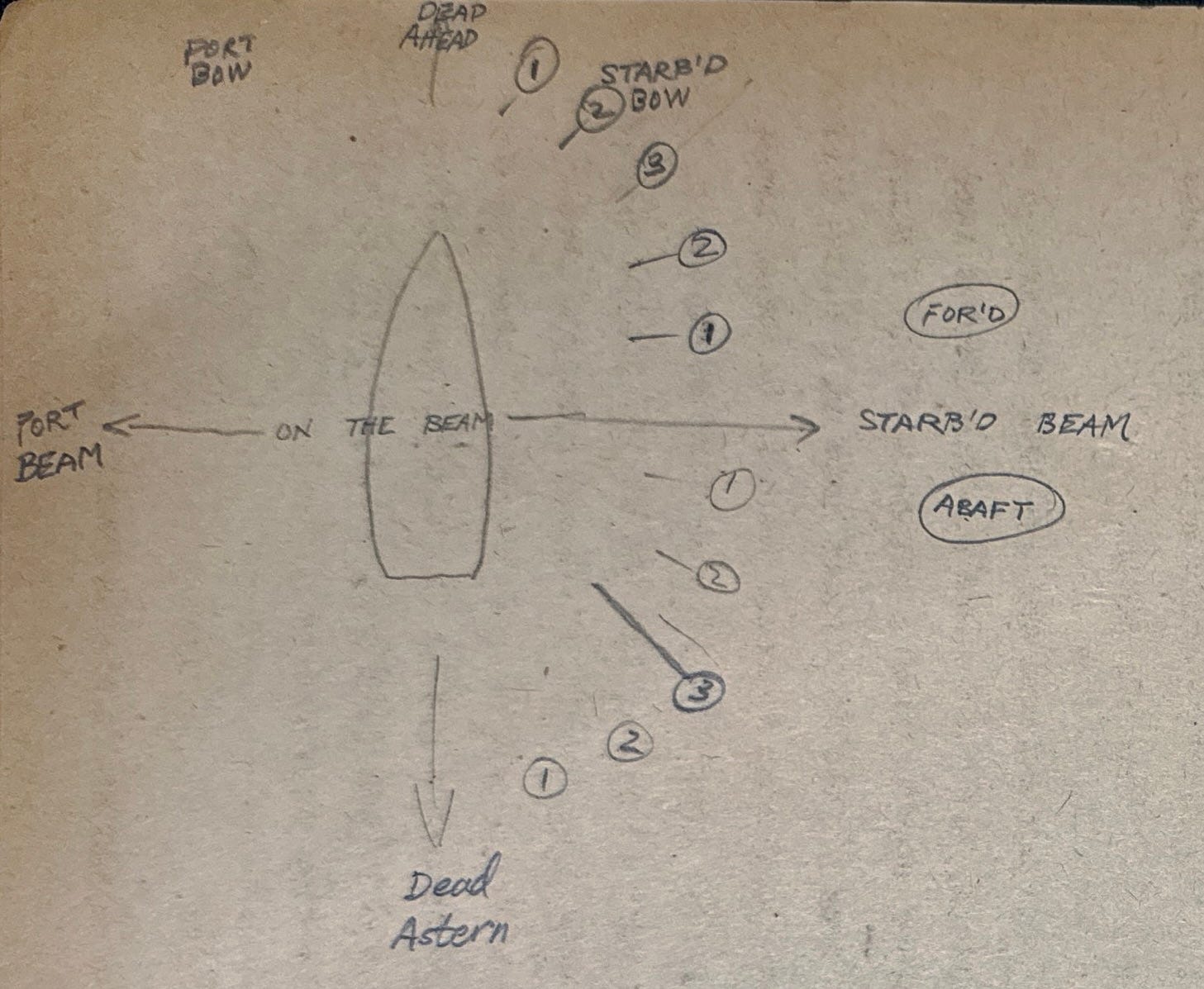
What do you do in contrary winds? Why, that’s easy. You tack. You push that old boom around to get the sail in different positions—two points abaft the port beam, to go this way—then two points abaft the starboard beam, to go that way—to catch the wind—and you tack—you ZIG-ZAG along your course. And that’s what they probably did at first.
But the storm grew worse—the man at the stern-sheets hung on that old tiller for all he was worth. (STORM MUSIC) Their faces were worried now—they were drenched with spray—it had all happened so quickly! The swells were getting higher now—WHOP! That one almost swamped them! The wind was screaming—now they were terrified! This was no time for any mistakes!
“Furl the sail!”
They staggered as they went about doing it, grabbing things to keep from being washed overboard. CRASH! The sail collapsed.
“Don’t lash it down—just make the boom fast!”
They did—falling against each other.
“Look alive on that tiller! Don’t let her head slide off into the trough! Keep her headed into the waves!”
If the boat ever got pushed sideways, and got into the trough—into one of those gulleys, she was a goner! They headed into the waves—a wave would rise up like a mountain—like a giant wall—coming toward them—into it—right into it—right through it! Hang on—you couldn’t hear yourself think! It would break over them—then they’d be down—as if they were crouching—waiting for the next wave to come. The man at the tiller steered desperately. It was straight into the waves—or die! Then up, up, UP—P-l-u-n-g-e over the top of the next one! Now it wasn’t ‘get to the other side’—getting anywhere didn’t matter—it was just stay on top—just stay alive— They’d never make it—they were goners—
And then someone saw it.
He was pointing three points abaft the starboard beam—back toward the stern—they hardly heard his cry, the wind was so loud—but they saw his face—saw him point—and they all looked.
Oh NO. Were they losing their minds? What sort of nightmare was this? The waves, they could fight—but this!—Yea, it would be better to drown—this was a GHOST walking on the water! They cried out—and their cries were lost in the howling sea!
MUSIC OUT
And then—a voice came over the waves—how clearly they could hear THAT—”Be not afraid—it is I.” (OUT)
No—it couldn’t be—but—oh joy of joys, it WAS—it was Jesus! Now the boat was going aimlessly, up over the swells and down again—as they clung to the oars and watched Him coming toward them.
Peter clung to the edge of the boat—excitement had carried him beyond all reason—he called out, “Lord if it is You, tell me to come to You— on the water!”
And the Lord held out His hand and said, “Come!”
The other disciples were rooted to the spot. They watched in wonder as Peter hiked himself over the edge of the boat—let himself down to the water—and began to WALK —TOWARD—JESUS—ON—TOP—OF—THE—WATER!
No one spoke. They hardly breathed. Peter—walking on water! Peter went toward his Lord like a man in a dream, closer—closer—then, suddenly, like a person “coming to”—he felt the wind whipping his clothes about him, felt the spray in his face—saw the foaming waters—heard the howling wind—OHHHHHH—he began to sink—tread water to keep his head up—”MASTER, Lord, save—me!”
And the Lord stretched out His hand—lifted Peter up—and this time, he stayed up—his hand in the Lord’s hand.
“Peter, why didn’t you believe—that I could hold you up?” It was the Lord’s voice, scolding—but it was tender.
Together, they walked back to the boat—and somehow, where Jesus was, the waves were gentle swells, though the waters broke and crashed all about them. And when Jesus got in that boat—the waters became quiet—the wind stopped blowing—the storm had stopped!
MUSIC: OUT
We just can’t imagine how amazed and full of wonder those men were. They were too amazed to do much talking. They could only kneel before Him in the boat, and whisper, “Truly Thou art the Son of God.”
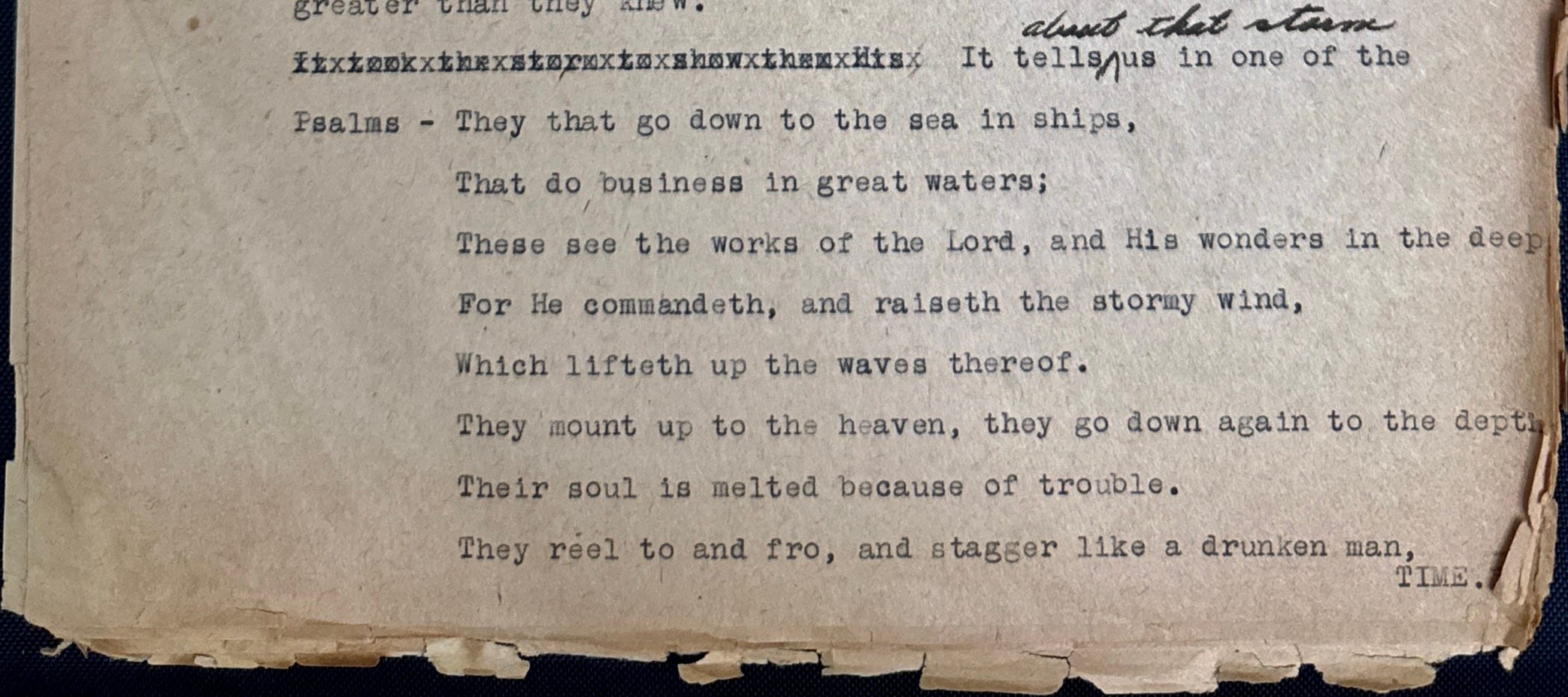
It doesn’t tell us in God’s word that they took to the oars, or hoisted the sail—or did any of the things they would ordinarily do to get the boat to shore. No—the master of the sea was in the boat. He guided it safely to the other side—and they found themselves right in the place where they wanted to be. They had wanted Him to be King—He had refused—but in His own way, He had let them know that He WAS a king—far greater than they knew. It tells us in one of the Psalms—
They that go down to the sea in ships, That do business in great waters; These see the works of the Lord, and His wonders in the deep. For He commandeth, and raiseth the stormy wind, Which lifteth up the waves thereof. They mount up to the heaven, they go down again to the depths. Their soul is melted because of trouble. They reel to and fro, and stagger like a drunken man, And are at their wit’s end. Then they cry unto the Lord in their trouble, And He bringeth them out of their distresses. He maketh the storm a calm, so that the waves thereof are still. Then are they glad because they be quiet; So He bringeth them unto their desired haven. Oh that men would praise the Lord for His goodness, And for His wonderful works to the children of men!2
BOY: Then they cry to the Lord in their trouble and He brings them out of it. Thank you, mother.
MOTHER: Tell the Lord your troubles. Talk to Him about your storms. And ask Him to calm the storm and deliver you. I don’t know what your problem is, and I don’t want to, right now! But tell the Lord. If the class has gone on to something new that you can’t get through your head—long division—fractions—Ohhhh. I used to be dumb in fractions, ’till I got the hang of it—and you’re going to school with a lump in your chest because you don’t know the work—Talk to the Lord about it. Then ask for help—and the Lord will make that teacher patient. Or if somebody else got blamed for something you did—and you didn’t admit it right on the spot, and now it’s hard to—He’ll help you make it right.
Those things are STORMS—come into your life to make you grow and give you spiritual muscles! You’ll never be a man worth anything to God, without the storms. But He’s always there—waiting to help. All you have to do is call on Him. You don’t have to go down under the water and get licked. Just throw up your hands like Peter did and say, “Lord help me!” See?
BOY: (SIGH) Yep. I know what I have to do. I knew all along, but it’s going to be easier now to do it.
MOTHER: Going to take care of it now?
BOY: Yep. Right now. That’s funny—
MOTHER: What?
BOY: Before I wasn’t hungry. I felt kinda sick. But now I’m hungry. What’s for dinner? I’ll be back in time to get washed for dinner.
MOTHER: (LAUGHING) Nothing’s for dinner—if I don’t get busy. Be home by five-thirty!
BOY: Okay! Bye!
MUSIC: WIND UP
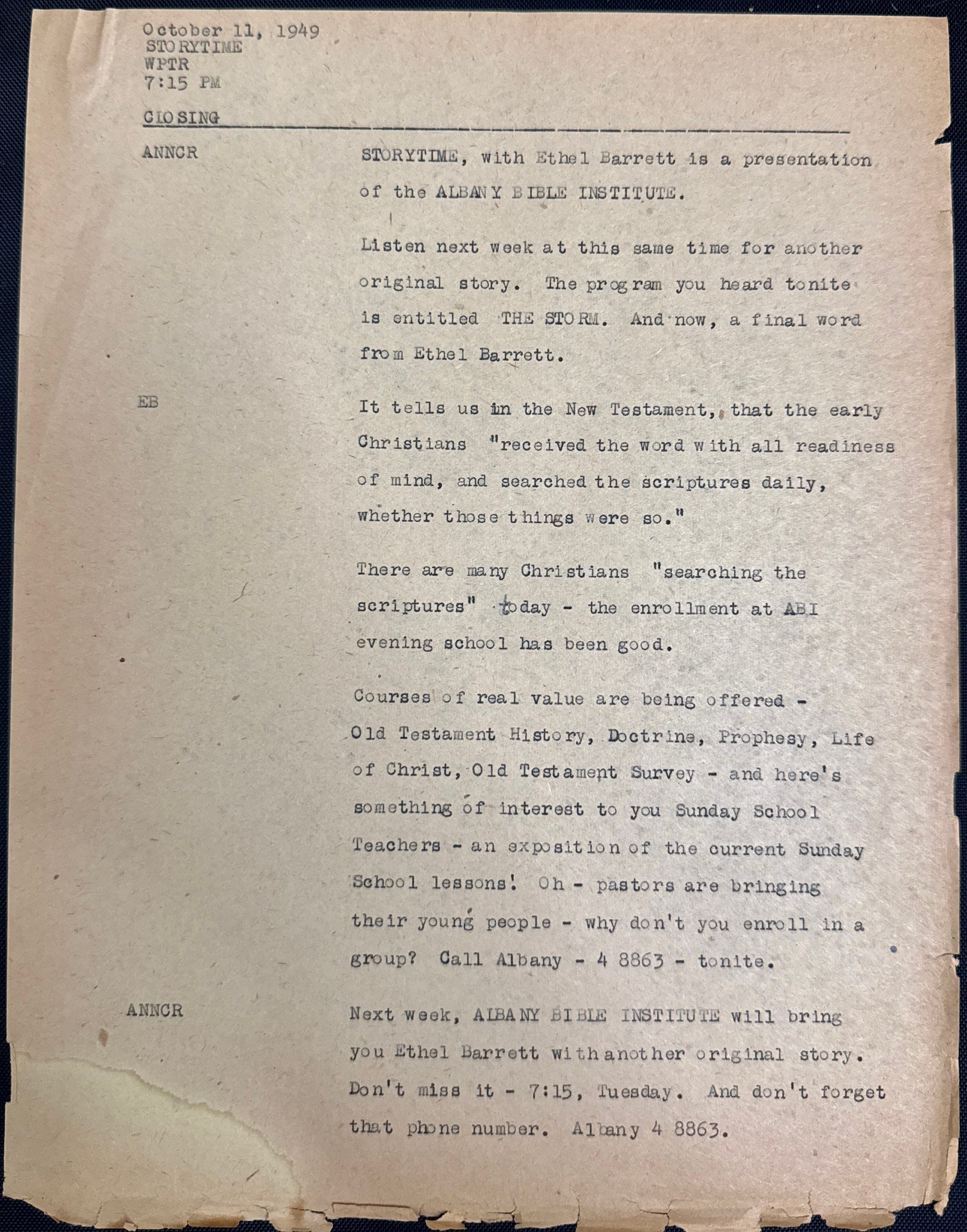
CLOSING
ANNCR: STORYTIME, with Ethel Barrett is a presentation of the ALBANY BIBLE INSTITUTE.
Listen next week at this same time for another original story. The program you heard tonite is entitled THE STORM. And now, a final word from Ethel Barrett.
ETHEL BARRETT: It tells us in the New Testament, that the early Christians “received the word with all readiness of mind, and searched the scriptures daily, whether those things were so.”
There are many Christians “searching the scriptures” today—the enrollment at ABI evening school has been good.
Courses of real value are being offered—Old Testament History, Doctrine, Prophesy, Life of Christ, Old Testament Survey—and here’s something of interest to you Sunday School Teachers—an exposition of the current Sunday School lessons! Oh—pastors are bringing their young people—why don’t you enroll in a group? Call Albany—4 8863—tonite.
ANNCR: Next week, ALBANY BIBLE INSTITUTE will bring you Ethel Barrett with another original story. Don’t miss it—7:15, Tuesday. And don’t forget that phone number. Albany 4-8863.
Historical Note: The 1949 NRB Award
The National Religious Broadcasters (NRB) was founded in 1944 to protect the rights of evangelical broadcasters during a period when major networks (NBC, CBS, and Mutual) were increasingly restricting religious airtime.
By 1949, the year this script aired, the NRB had successfully lobbied the newly formed ABC network to reverse its ban on paid religious broadcasting.3 Ethel Barrett’s first-place win in the NRB’s nationwide competition that same year signaled a major shift toward professional excellence in Christian media.4
Copyright © 1949, 2026 by Barrett Enterprises, LLC. All rights reserved.
“Transcribed program" refers to the 1940s industry standard of distributing pre-recorded shows via 16-inch electrical transcription (ET) discs for syndication. (Hangen, Tona J. Redeeming the Dial: Radio, Religion, and Popular Culture in America. University of North Carolina Press, 2002).
Psalm 107:23–31 (King James Version), often referred to as the "Sailor’s Psalm."
National Religious Broadcasters (NRB). “Our History: The 1949 Turning Point.” NRB.org
Ward, Mark. Air of Salvation: The Story of Christian Broadcasting. Baker Books, 1994. Note: Ward highlights the late 1940s shift from simple sermon broadcasts to the “narrative excellence” pioneered by storytellers like Ethel Barrett.