
Achan
A compelling retelling of a hidden choice, a devastating defeat, and the high cost of a "little thing."

From the vaults of the 1940s airwaves: An adaptation of Ethel Barrett’s radio script, tracking a timeless story of hidden choices and monumental consequences.
“The wages of sin is death.”
It is an ancient, heavy truth, sounding out like a funeral toll—that slow, single iron strike that echoes through a valley to mark the end of a life. It is a sound that vibrates in your chest, unhurried and absolute. This is the story of a man who heard that warning, looked that truth in the face, and chose to look away. He disobeyed. He didn’t slip, he didn’t stumble; he knowingly, deliberately disobeyed a solemn command of God. This is the story of what happened to him. This is the story of Achan.
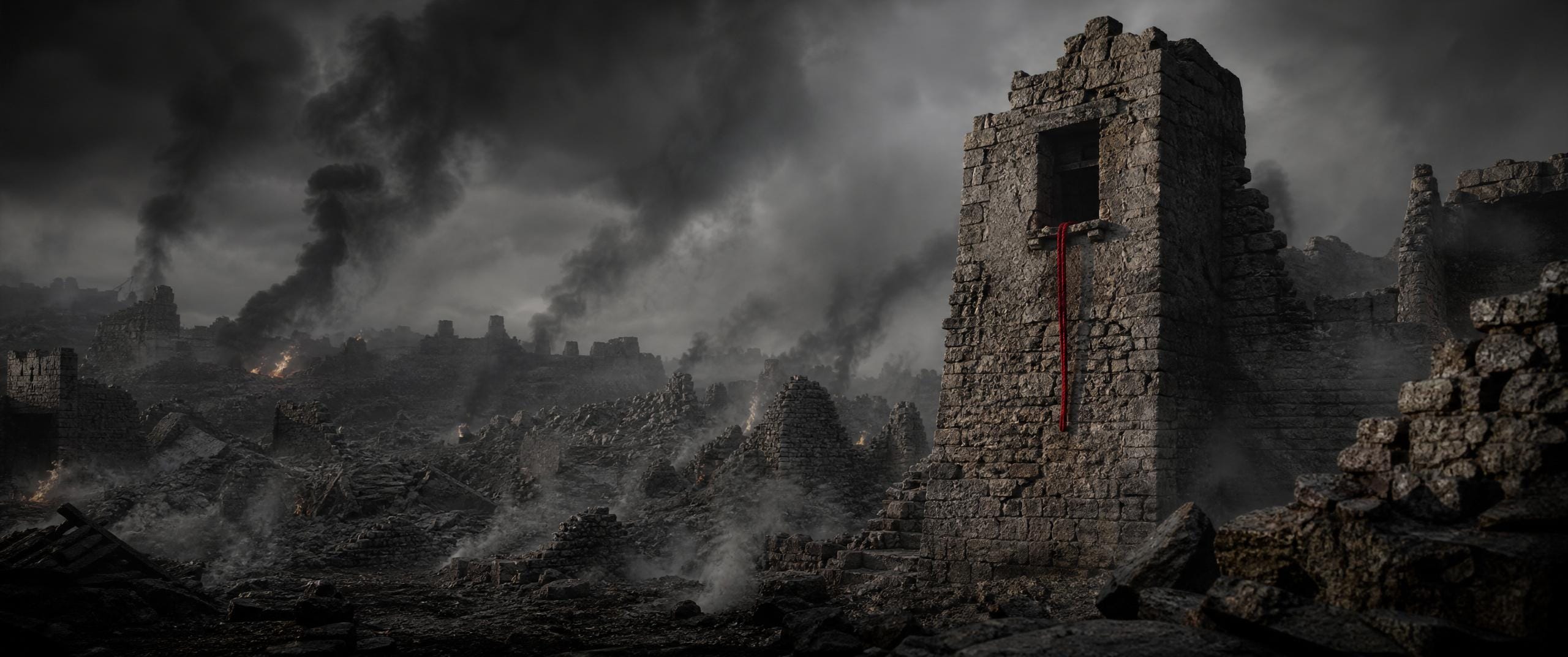
The grand, miraculous drama of the conquest was over. The Israelites had taken the city of Jericho in a way that defied all military reason. For seven days they had marched—once a day for six days, and then a roaring seven times on the final day—with the priests blowing ram’s horns and the entire army raising a mighty shout. Then, the impossible. The massive walls had crashed outward, collapsing into heaps, dragging the inner structures down with them as the army surged forward to victory. Only Rahab—a prostitute living on the literal edge of a wicked city who had chosen to believe God and protect His spies—was saved, along with her family, behind the window marked by that single, bright scarlet cord.
But now, the thunder of falling walls had faded into a grim, busy silence. Jericho was a shattered ruin, some of it still smoldering, sending up lazy plumes of bitter smoke into the heat. The thrill of battle had dissolved into the hot, grueling business of salvage. Methodically, the soldiers went about stripping the city of its wealth.
Achan grunted, stooping low to duck under a massive, charred beam that had fallen diagonally across a doorway. He straightened up into the stifling heat, pushed a mat of sweaty hair off his face, and blew his nose. Phew. The dust was thick enough to choke a man. It coated his throat, stung his eyes, and mixed with the sweat trickling down his neck. It was hard, exhausting work.
Everywhere around him, men were hauling out gold, silver, brass, and iron—every ounce of wealth that could be clawed out of the rubble. But none of it belonged to them. The orders from General Joshua had been absolute, echoed through every camp and line: No one is to keep anything for himself. Everything was set aside, strictly devoted to the treasury of the Lord.
Achan kicked idly through a pile of rubbish inside what had once been a wealthy estate. Most of the roof had burned away, and through the open gaps, he could hear the distant, muffled shouts of other soldiers calling back and forth to one another in the streets outside. He was entirely alone in the quiet wreckage.
Then, his foot struck something solid.
He looked down. Hmmm. What was this?
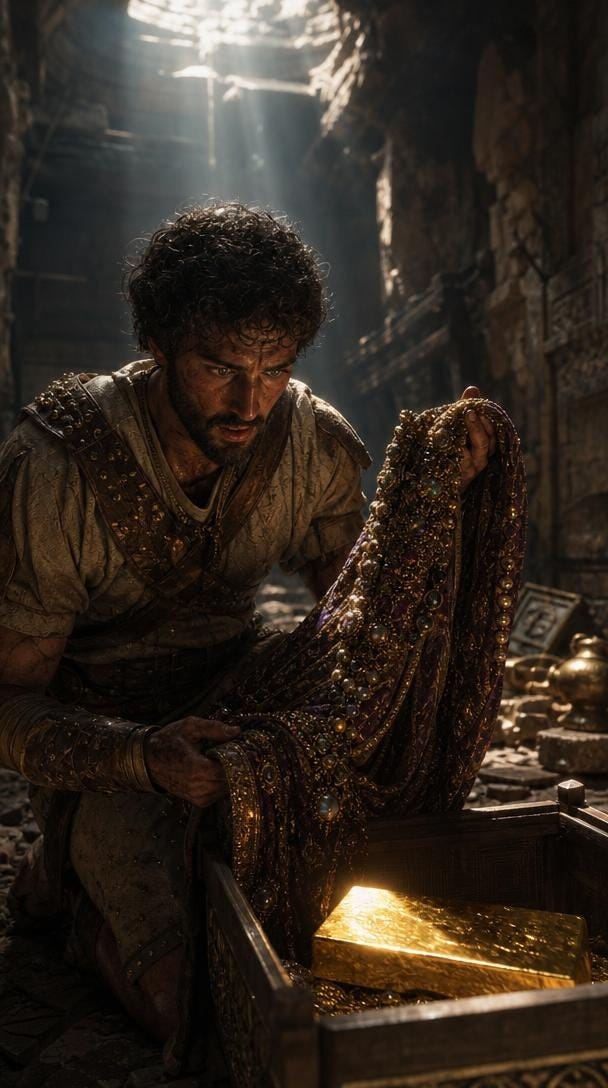
It was a beautiful cedar box, miraculously untouched by the fire. He knelt in the dust, his fingers tracing the smooth wood before he pried it open. Inside were books, fine clothes, and then—ahhhhh. He pulled it out, his breath catching in his throat. A robe. It was the most magnificent garment he had ever laid eyes on, imported from Babylon, embroidered intricately with pearls and glittering with precious jewels. It was a robe fit for a king.
Achan shot a quick, furtive glance over his shoulder toward the doorway. Nothing but the empty street. No one was watching. It was so lovely. Surely it wouldn’t hurt just to feel the weight of it? Just to sort of throw it over his shoulders for a brief second? He draped the heavy luxury over his dusty arms. Imagine wearing something like this! The sheer regal feel of it. For a moment, standing in the ruins, he didn’t feel like a weary soldier; he looked like royalty.
His eyes darted back to the open cedar box. What else was hidden under the silk? He reached deeper, his hands sweeping through the contents. His fingers wrapped around something heavy and smooth. A wedge of gold! It must weigh fifty shekels if it weighed a single one. And there, beneath it—his heart beat faster—silver! Not just a few loose coins, but a massive hoard of it. Two hundred shekels at the very least.
A thought crept into his mind, smooth and echoing like a physical voice in the quiet room. You are completely alone, Achan
.
No, no, he thought, his conscience putting up a weak, trembling defense.
The thought persisted, growing louder, bolder. Be still and look at it. If you had that money, if you kept that valuable mantle... you’ve never had anything like that in your life. Look at what you’re wearing.
I know... Achan stared at the gold in his hand.
You’ve always worn homespun, homemade clothes, the inner voice whispered, pressing into his deep-seated envy. If you take that and save it, some day when this campaign is over, you’d be a wealthy man. Maybe even a nobleman among your people.
Maybe a nobleman! Achan’s chest tightened with ambition. Yeah. It’s such a little bit to them. The treasury is going to be full to bursting with the riches of the whole city. The priests will never even miss it.
It’s such a little bit, the voice agreed, comforting him. Such a little bit. It couldn’t be too wrong, after all. It isn’t like you’re robbing your own brother or your neighbor. You’re just taking a tiny part of a massive pile that belonged to your enemies anyway.
A cold spike of reality hit him. But what if I’m caught?
You’re all alone in here, Achan. Hide it now. You can always come back for it later when the search parties are done.
It’s too heavy, he reasoned, his hands shaking. It’s too heavy to carry back to camp alone.
Your family will help you.
My family? The thought of involving Martha and his sons made him hesitate.
They will understand, the voice reassured him, soothing his guilt. It’s such a little bit. No one else in the whole camp will ever know, Achan. It’s your own personal business. Your own private affair.
Achan sucked in a breath, his moral resolve collapsing. Of course. My own affair. After all...
“Hooooooo!”
The distant shout from the street shattered the quiet. Someone was coming.
Make your decision now, Achan, the urgency screamed inside his head. Decide!
“Hooooooo—” the voice called again, closer this time. “Anything in there?”
Achan froze, swallowed hard, and forced his voice to sound casual. “No—not a thing! I—I’m coming right out!”
His mind was made up. With frantic, clumsy speed, he stuffed the heavy silver, the golden wedge, and the glittering Babylonian robe back into the chest. He shoved the box deeper into the dark corner, piled a heap of charred rubbish over it until it was completely hidden, and swung himself down through the broken masonry into the blinding sunlight of the street.
His heart was hammering so violently against his ribs that his chest ached.
All through the long afternoon, Achan worked alongside the other men, tugging at heavy treasures and carrying them off to the central depository. He said very little, keeping his head down. His mind wasn’t on the work. It was fixed entirely on what he had done, and what he must do next. There would be the telling of Martha and his sons. He would have to convince them, to make them see the gold and the robe exactly the way he did. That might be hard.
But the treasure was far too heavy for one man to move or hide alone. He remembered how the thought had started out as his own personal affair. Still, he needed them.
In the end, it hadn’t been nearly as difficult as he feared. His family had seen the logic in it too. It was only taking from an enemy, after all, and it was such a small amount compared to the rest. When they finally settled into their permanent inheritances in the Promised Land, they wouldn’t be poor farmers anymore; they would be rich.
Long after the great camp of Israel had grown quiet and the fires had died down to embers, the silhouettes of Achan and his family detached themselves from their tent. They moved like ghosts, losing themselves in the deep shadows, slipping back up the rubbish-filled street of the ruined city. They moved quickly past the wide, open spaces that were brightly illuminated by the cold moonlight, ducking from wall to wall until they reached the wreckage. Yes, this was the house.
Inside the family tent, far into the dark hours of the night, there was the faint, rhythmic sound of furtive digging. Scrape, dig, scrape. They worked in the dark, scooping out the earth beneath the floorboards until the hole was deep enough. Deep enough to bury the treasure. Deep enough to bury all trace of it. Deep enough to bury all knowledge of what they had done.
The morning sun arrived, and with it, the terror of the night seemed to evaporate like the mist. The bright daylight made the whole thing seem like a dream, rendering it reasonable, sensible—even safe. At least, it didn’t feel like some monumental crisis anymore. With the return of daily chores, military duties, and the ordinary business of camp life, the hidden box was pushed into the deep background of Achan’s mind. And his conscience, exhausted from the constant warnings, finally fell silent.
And then!
A sudden blast of a bugle shattered the morning air.
Orders had come down from headquarters: Prepare to attack Ai! Ai was the next stop on the campaign. The scouts had returned with glowing reports. It would be an easy victory, a total cake walk! The city was much smaller and far weaker than Jericho. Only a small detachment would even be necessary to take it. The groundwork was already laid, and a meager three thousand men were assigned to go up and take the gates. The rest of the vast army would stay behind in the comfort of the camp, relaxing while they waited for the inevitable news of victory.
But the news that came back wasn’t victory.
Somehow, incredibly, the disciplined men of Israel had broken. The armies of Ai had struck them at the gates, chasing them down the steep hill like sheep. The Israelites had panicked, broken ranks, and fled in absolute, chaotic disorder back to the safety of the main camp. Thirty-six Israelite soldiers had been cut down and killed.
The camp was paralyzed with shock. What had happened? How could this be?
Joshua fell face down in the dust before the Ark, tearing his clothes. All the elders of Israel joined him, weeping and praying through the long hours. What is wrong? Why did You bring us this far, only to give us over to defeat? What will the heathen nations think of Your great name when they hear of this? They will surround us and wipe us off the face of the earth!
And in the heavy silence of the sanctuary, God spoke. “Get up.”
Joshua lifted his face from the dirt.
I am a great God, the divine response came, terrifyingly clear. But I am also a holy God. And Israel has sinned.
The words hit like thunder.
Someone has taken what I have forbidden. Someone has taken what I explicitly set aside for Myself. Someone has disobeyed. Someone has stolen. Someone has lied. Someone has hidden the accursed thing among their own goods. Can I bless you and give you victory under a curse? No.
The next morning brought the most amazing, terrifying probe ever put on record. By divine command, the entire camp of Israel—thousands upon thousands of men, women, and children—was summoned to assemble by tribes.
The bugles blew a long, solemn note. Achan stood in the ranks, his palms sweating, his throat dry. He watched the massive lines begin to move past the elders and past General Joshua, who stood waiting for God to point out where the rot lay. Achan waited too, trying to maintain a calm expression. It seemed totally unreal, fantastic, impossible. It couldn’t be about his box. It couldn’t be about that. No. It was such a little thing...
The voices of the leaders echoed across the valley as the lots were cast, tribe by tribe.
“Reuben... Simeon... Levi...”
Achan watched them pass.
“Judah... Dan... Gad... Asher... Benjamin...”
And then the announcement cut through the air like a knife. Judah! JUDAH WAS THE TRIBE!
An ominous, suffocating dread settled over the assembly. The rest of the morning became a waking nightmare. The families of the great tribe of Judah were ordered to march past the elders, clan by clan, household by household.
Achan stood shoulder-to-shoulder with his family, staring straight ahead, his eyes fixed on nothing. His wife leaned in close, her voice a trembling whisper.
“Achan. I’m frightened.”
“Why?” he hissed through gnarred teeth, not moving a muscle.
“Achan... you’re frightened too.”
“Hush.”
“You are,” she whispered, her voice rising in panic. “The sweat is running right down your face. Achan... do you think that could be it?”
“Quiet, woman! I do not know what to think.”
“It was such a little thing—”
“Shut up!”
But the word echoed inside his own skull, mocking him. Such a little thing, Achan.
I know, I know...
Your family is next, Achan. Walk past with your head up. Keep your head up. Your head up...
The line moved. A voice called out from the front of the judgment seat. “This is the family.”
No. The world seemed to spin.
The crowd of onlookers began to buzz, a low, menacing murmur rising from the thousands of spectators.
“That’s the family...”
“Look, it’s Achan’s family!”
“They’re going to make them walk by separately now!”
The crowd noise suddenly drowned out into a dead, terrifying silence as Joshua looked directly at them.
Walk by now with your head up, Achan—with your head—
“Bring him to me,” Joshua’s voice rang out across the clearing. “This is the one.”
Achan’s legs turned to water. He stumbled forward, his voice dropping to a broken whisper. “Yes, Sire—”
Joshua looked down at him, his face etched with sorrow and gravity. “What have you done?”
The words spilled out of him in a desperate, broken torrent. “I have buried treasure in my tent! I will show you—silver, gold, I will show you! You can have it, it is accursed! I’ll show you, just take it back! I’ll show you my treasure... there was a robe, fit for a king...” He collapsed into loud, wretched weeping. “It... it was... such a... little thing.”
Joshua’s eyes were heavy with judgment. “You have not sinned unto yourself alone, Achan. Your family is involved. Because of this, thirty-six soldiers have been killed, and many more are wounded. You have not robbed Jericho. You have robbed God. Take them away—their punishment is death.”
Sometimes, when I think of the tragic story of Achan, I find myself thinking about the sins that creep so quietly into my own life. The subtle, hidden things that look so small but completely rob me of spiritual victory—sins that I comfortably label as “little things.”
Sometimes I think of tithing, and I look more diligently to my job as a steward, ensuring I give back to God what is already His—at the very least, a tenth.
And sometimes I think of obedience in things large and small alike, and what a solemn, terrible transgression willful disobedience really is.
What do you think of Achan’s sin? It was written down in the pages of Scripture for your example, so that you might profit by his failure, look to your own heart, and live.
Behind the Script: Ethel’s Translation Style
Readers familiar with Ethel Barrett’s later books and recordings know she frequently quoted from the clear, contemporary language of The Living Bible. However, when this script was written and broadcast in the late 1940s, modern paraphrases did not yet exist. In this era, a Presbyterian influenced writer like Ethel would have studied the classic text of the King James Version, but dynamically translated the archaic phrasing on the fly into vibrant, dramatic American English to suit the fast pace of radio. The conversational language in this narrative prose is a direct reflection of that early, innovative storytelling craft.
Scriptural Foundations
The historical account and theological themes woven throughout Ethel’s original script can be found in the following biblical passages:
The Narrative Outline: Joshua chapters 6 and 7
The Stolen Hoard Details: Joshua 7:21
The Opening Theme: Romans 6:23